
What People Often Forget About CSA
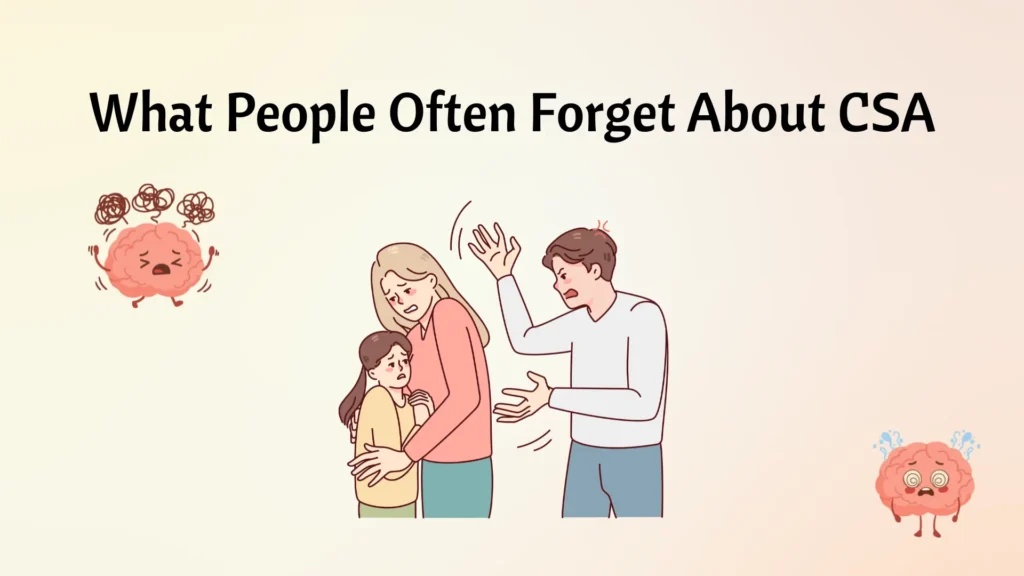
Most people imagine child sexual abuse as one incident, one moment of violence that suddenly tears a child’s world apart. But the truth is quieter and more unsettling. CSA does not begin with the act. It begins long before anyone names it as abuse. It begins with trust. Every study on CSA in India shows the same pattern: in most cases, the child already knows the abuser. Not just knows, but trusts, respects or depends on them. NCRB data and multiple POCSO court judgments reveal that many offenders come from within the child’s daily circle: relatives who visit often, neighbours who offer help, teachers or tutors who appear dependable, even older adolescents who become the child’s “guide”. The harm grows in the silence between these interactions.
This is where grooming exists. A deliberate, careful process of breaking down boundaries while appearing affectionate, responsible or caring. It is the abuse before the abuse. The crime that often leaves no visible mark but changes everything. Understanding grooming matters because it allows us to prevent CSA before the first touch, the first message or the first violation. Prevention begins with recognising patterns that hide in ordinary behaviour: too many gifts, too much familiarity, too many secrets shared with an adult who should not be keeping secrets with a child. Recognising grooming is not about suspicion. It is about awareness. It is about keeping children safe long before the law is invoked. Children deserve safety that starts early, conscious safety, safety that does not wait for harm to happen. Grooming awareness is our first line of defence.
What Grooming Is and Why It Works
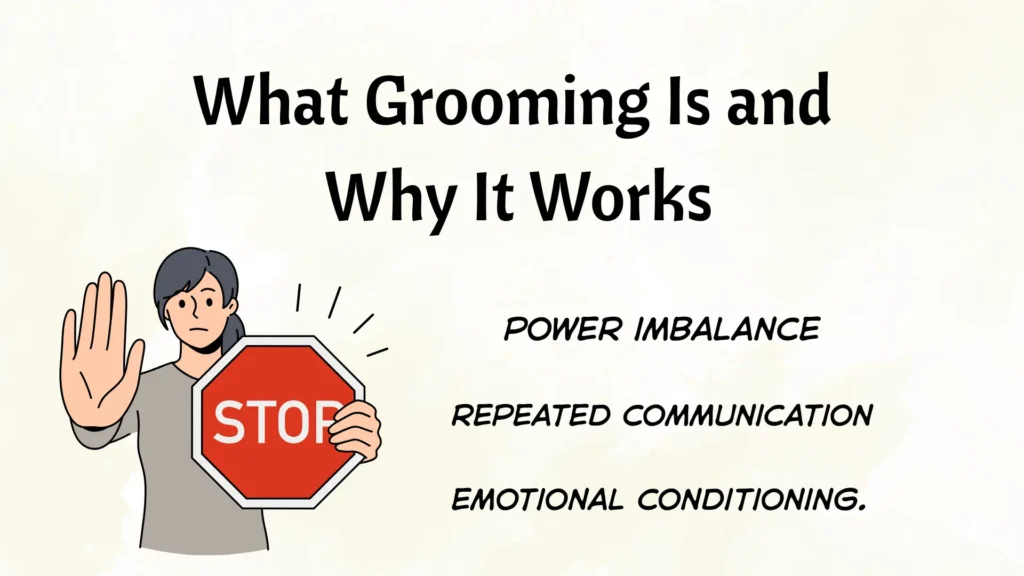
Grooming is the hidden foundation on which most child sexual abuse rests. It is not a moment but a method. A slow, deliberate sequence through which an offender creates comfort for the child and cover for themselves. In India, where family networks are close and adults are routinely trusted with children, grooming becomes even more invisible. It slips into everyday life disguised as affection, concern or support.
Legally, grooming sits at the core of the Protection of Children from Sexual Offences Act. Though the Act does not use the word grooming directly, it recognises behaviour that signals sexual intent long before physical contact. Under Sections 11 and 12, repeated communication, suggestive remarks, attempts at isolation, insistence on secrecy, or targeted attention can amount to sexual harassment or preparation for abuse. Courts do not wait for a completed act. They analyse patterns. They look at who initiated closeness, how boundaries shifted, and whether the child was made emotionally or physically accessible. Indian judgments emphasise that the steps leading up to abuse are as revealing as the abuse itself because they show intention.
Psychologists describe grooming as a manipulation of vulnerabilities. Offenders identify what a child needs: validation, attention, help with studies, emotional warmth or escape from loneliness. They also read the family environment. Parents who work long hours. Homes with frequent visitors. Households where children are taught not to say no to elders. These everyday realities become opportunities. Offenders position themselves as protectors, mentors or “the only person who understands”. Over time, the child comes to depend on them emotionally or socially. This dependency is the strongest weapon in the offender’s hands.
Grooming works because of the power imbalance between adults and children. In Indian households, respect for elders is a deeply ingrained cultural value. Children are taught to trust adults automatically. Offenders exploit this obedience. They do not use force at first; they use familiarity. A neighbour who always plays with the child. A cousin who insists on alone time. A tuition teacher who comforts the child after a test. Nothing looks criminal in isolation, yet each interaction slowly changes the child’s idea of what is normal. It also works because of emotional conditioning. The offender makes the child feel special. They allow the child to confide in them. They listen, praise, and reassure. The child begins to see them as a safe space, even when behaviour becomes inappropriate. Love, loyalty and confusion mix, making the child unsure whether something is wrong or whether they simply misunderstood.
One of the most dangerous elements of grooming is secrecy. Offenders introduce the idea slowly. “This is just between us.” “Your parents will get angry.” “Nobody will understand.” These statements do not frighten the child at first. They feel like shared intimacy. But they become psychological restraints that keep the child silent even when discomfort grows. Indian case studies under POCSO repeatedly show that children often hide abuse because they do not want a trusted adult to get into trouble, or because the abuser convinced them that the child caused it.
Grooming also succeeds because adults around the child overlook subtle signs. A gift from a neighbour is seen as a sign of generosity. Late-night texts from a tutor are considered dedication. A relative insisting on spending time alone with a child is interpreted as affection. This adult blindness allows the offender to move freely without suspicion. Ultimately, grooming works not because children fail to recognise danger, but because adults fail to recognise patterns. Understanding what grooming is and why it succeeds is the first step in preventing CSA before it begins. It is the awareness that turns everyday interactions into spaces of vigilance rather than vulnerability.
How Grooming Actually Works: The Hidden Stages People Mistake for Care
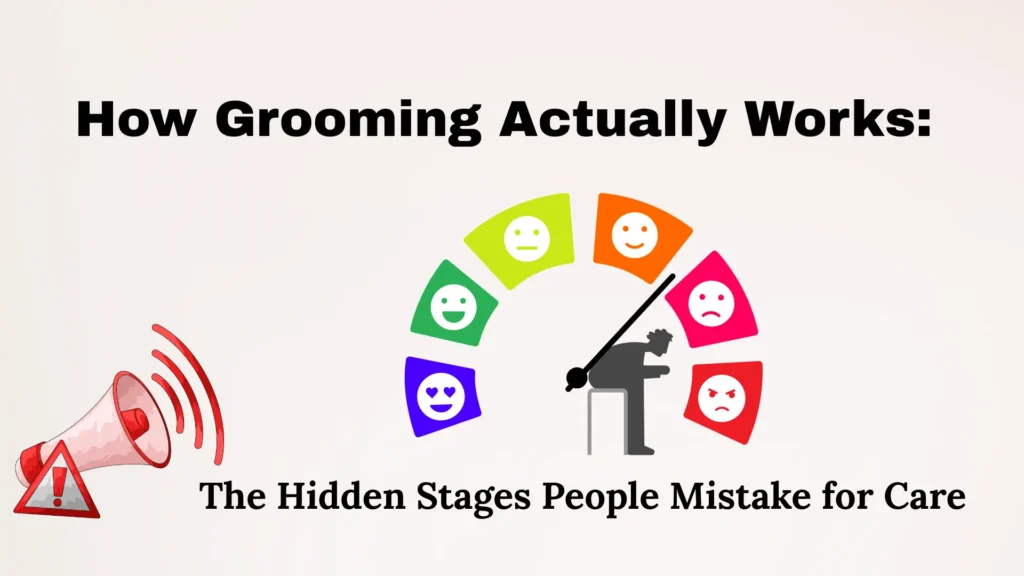
Grooming is rarely loud, violent, or sudden. It does not begin with abuse. It begins with attention. With care. With what looks like concern. This is precisely why grooming is so often misunderstood and overlooked. Legally and psychologically, grooming is recognised as a process, not a single act. Indian courts, particularly while interpreting cases under the Protection of Children from Sexual Offences framework, have repeatedly acknowledged that pre-offence conduct plays a crucial role in understanding both the crime and a child’s delayed or confused response. What appears harmless in isolation becomes dangerous when seen as a pattern.
The process usually begins with attention and familiarity. An adult starts noticing a child more than others do. They remember small details, preferences, moods, insecurities. The child begins to feel seen in a way they may not have felt before. Statements like “You’re the only one who understands me” or “You can talk to me anytime, I’m always here for you” may sound emotionally supportive, but they also create a sense of specialness and exclusivity. The child starts associating safety and validation with that one person.
Slowly, this attention turns into dependence through favours or gifts. These are rarely extravagant. They are small, strategic, and easy to justify: snacks, phone recharges, stationery, extra academic help, or access to something the child values. Along with the gift often comes secrecy. “Don’t tell your parents, they’ll think I’m spoiling you” or “This is just between us” subtly teaches the child that keeping secrets is normal, even necessary. Once secrecy is established, isolation and emotional bonding follow naturally. The offender positions themselves as the only one who truly understands the child. Friends, parents, and teachers are slowly framed as people who “won’t get it.” Phrases like “No one else cares for you the way I do” or “We understand each other better than anyone else” reinforce emotional dependence. The child may withdraw from others, not because they are forced to, but because they feel safest with the offender.
After emotional closeness feels normal, boundaries begin to blur. Physical contact is introduced gradually and always with an excuse. Sitting too close, unnecessary hugs, fixing clothes, holding hands while “helping.” Each act is framed as care. “I’m just helping you” or “You’re like my own child” are used to normalise touch and silence discomfort. The child may feel uneasy but struggle to articulate why, because nothing appears overtly wrong. When hesitation or resistance arises, guilt, fear, or manipulated loyalty is introduced to maintain control. The tone shifts subtly. The child is reminded of consequences. “If you tell anyone, everyone will blame you” or “Don’t ruin my life, I trusted you” place responsibility on the child. Silence is no longer a choice; it becomes a burden the child feels obligated to carry.
These stages do not exist in theory alone. They play out daily, both online and offline.
Consider the case of an online mentor. A 14-year-old student in Bengaluru follows a popular art mentor on Instagram. It starts with public praise on her posts, comments appreciating her “unique talent.” Gradually, the interaction moves into private messages. He asks about her day, her school, her friends. He offers free tutorials and exclusive resources, making her feel chosen. Late-night chats begin. He says, “Don’t show these messages to anyone, only we understand each other.” Eventually, he asks for pictures under the guise of giving feedback. By this point, the child is emotionally dependent and has stopped sharing her online interactions with her parents. Each step attention, special access, secrecy, isolation is textbook grooming, executed digitally.
Or consider a more familiar setting. A 12-year-old child in Pune faces bullying at school. She feels lonely and insecure. A neighbour notices this vulnerability and begins paying attention, asking about her day, praising her intelligence, offering small treats. He starts helping her with homework and invites her to spend time alone under harmless pretexts like errands or projects. Gifts and emotional reassurance follow. “I’m the only one who really understands you.” Slowly, physical boundaries are crossed sitting too close, guiding her hands unnecessarily. When she hesitates, he reassures her, “Don’t tell your parents, they won’t understand. We have a special bond.” Every action looks caring. Together, they form a controlled environment of trust, secrecy, and dependence.
This is why grooming is so difficult to detect and so easy to dismiss. Each step, on its own, can be explained away. But grooming is not about a single moment. It is about a pattern. A gradual erosion of boundaries disguised as care. Understanding grooming requires us to stop asking why a child did not speak up earlier, and start asking how silence was carefully built around them.
Why Grooming Goes Unreported
Grooming survives because it is quiet. It grows in small moments that look harmless, affectionate, even respectable. And this is why it goes unnoticed in Indian homes, schools, neighbourhoods and even in the courts, unless one knows what to look for. Most people imagine a sexual offender as a stranger in the dark. But grooming exposes a harsher reality. Offenders are often familiar faces. The neighbour who helps with homework. The cousin who brings chocolates. The coach who gives “extra practice.” The tuition teacher who messages late at night. Their behaviour fits easily into everyday Indian life, so parents rarely see danger where affection appears to be blooming.
Children, too, rarely have the vocabulary to understand manipulation. The law recognises this. Courts under POCSO have repeatedly observed that inconsistency, hesitation or confusion in a child’s disclosure is not a weakness but a natural consequence of grooming. A child may feel ashamed, guilty, or afraid of hurting someone they trusted. Many genuinely believe they did something wrong. Some think the affection is real.
Grooming manufactures silence long before the abuse happens.
Fear of not being believed makes the silence even heavier. In India, social status often protects the offender. A child can clearly sense when the groomer is respected in the family or community. They understand who will be defended and who will be doubted. Children grow up
hearing phrases like “Respect elders,” “He is like family,” and “Don’t accuse someone without proof.” These cultural cues tell them that speaking up is risky, that adults will ask uncomfortable questions, and that family harmony matters more than their safety.
Family dynamics strengthen the silence. In many homes, obedience is praised and questioning an elder is discouraged. When the abuser is a relative, a friend of the family, or someone financially or emotionally important to the household, the child sees the potential chaos disclosure could create. They fear the anger, shame, or blame that may fall on their mother. They fear breaking the family. Groomers exploit this fear deliberately.
Understanding these layers of silence is essential for prevention. A child’s quietness is not consent. A delay in reporting is not a sign of fabrication. It is evidence of manipulation. The law, especially POCSO, places the burden on adults to recognise these early behaviours and treat every disclosure, even a late, hesitant one, as a serious sign of abuse. Protecting children begins with understanding why they struggle to speak at all.
How the Law Views Grooming
Indian law recognises that sexual abuse often starts before any physical act. Under the POCSO Act, behaviour showing sexual intent, such as giving gifts, creating secrecy, or isolating a child, can be legally considered preparatory conduct. Grooming establishes a deliberate pattern to gain access and control over the child, making early intervention legally significant. Courts treat these actions as evidence of intent, even without physical abuse. Reporting grooming promptly preserves evidence, helps track behavioural patterns, and can prevent escalation. Adults are legally obligated to act on suspicion rather than wait for harm to occur.
Grooming thrives in spaces where trust is unquestioned and patterns go unexamined. It is not anaccident or a misunderstanding, but a calculated process that exploits vulnerability, silence, and social conditioning. The danger lies not only in the offender’s intent, but in how easily ordinary behaviour is allowed to pass without scrutiny. Understanding grooming shifts the focus away from the child’s silence and onto the adult responsibility to notice, intervene, and protect. It reminds us that abuse does not begin when the law steps in, but when boundaries are quietly dismantled without resistance.